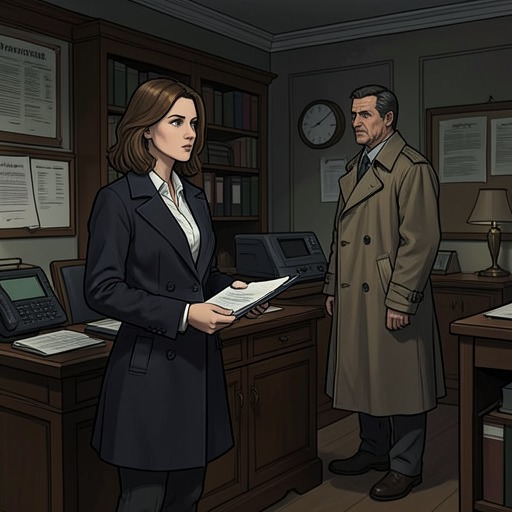
Parr’s permissive armed-response directive
The SonParr’s permissive armed-response directive authorizes a low threshold for lethal force against Sonny Lofthus, turning the police pursuit into an explicit risk of death. Parr tells Kari Adel that she and her colleagues will be treated sympathetically if they have to defend themselves, then stresses that the threshold for an armed response is low because Sonny has tortured a public servant. The order is later given to officers entering the Plaza Hotel: they are to prioritize their own safety and shoot to kill if necessary.
Warning to Kari
When Parr raises the possibility that Kari may be the officer who tracks Sonny down, he cautions her that Sonny is armed and dangerous. Kari brushes aside stray hairs and asks what Parr’s assurances mean. His answer makes the practical stakes plain: officers need not wait for an especially high degree of danger before using armed force. He invokes Sonny’s torture of a public servant to support that posture, while Kari accepts the warning without withdrawing from the investigation.
Parr also proposes that Kari and Åsmund Bjørnstad work together, believing that they share an understanding of the situation. The directive therefore accompanies the organization of the pursuit, not merely a general warning: Kari is being directed toward a search in which lethal force is expressly permitted.
Deployment at the Plaza Hotel
During the police operation at the Plaza Hotel, Bjørnstad reports the officers’ orders to Kari: their priority is their own safety, and they are to shoot to kill if necessary. Armed officers enter the reception area and the courtyard, while others move toward the back stairs and fire exit. Kari follows into the building and hears a door being forced open and stun grenades detonating before officers report that the area has been secured.
The operation gives the directive an immediate institutional form. The order is not confined to Parr’s private assurance to Kari; it governs officers moving through the hotel as they search for Sonny. The search culminates in the report that the area is clear, but the supplied evidence does not establish that officers fire on him during this operation.
Prison precedents and institutional context
The novel places this pursuit against earlier evidence of coercive power inside Staten Maximum Security Prison. Franck recounts the death of a prisoner who had worked for Hugo Nestor, explaining that concern he might talk was enough to make him vulnerable. He describes the possibility that control-room staff could leave a cell door unlocked, exposing prisoners to danger. This account shows how access, surveillance, and the threat of violence operate within the prison; it does not establish that Parr ordered the prisoner’s death or that the prison incident directly caused the later armed-response directive.
Franck’s conduct toward Johannes Halden offers another instance of institutional authority used as leverage: he threatens to withdraw Halden’s cancer treatment unless Halden reveals where Sonny is. Later, Sonny restrains Franck in his office, and Franck reflects on Sonny’s history of killing criminal associates. Elsewhere, Simon Kefas questions Iver Iversen about Kalle Farrisen and the Twin. These episodes illuminate the broader world of violence and compromised authority around the pursuit, but the evidence does not show them as parts of Parr’s order.
Meaning and limits
Parr’s assurance that Kari will be treated sympathetically and his explicit low-threshold instruction together frame lethal force as an anticipated, defensible outcome of the search. The shift from his conversation with Kari to the operational orders at the hotel shows how permission issued at the top can shape the conduct expected of armed officers. The directive places the state’s power to use force in tense proximity to the violence attributed to Sonny, while still distinguishing official orders from the prison threats and criminal coercion elsewhere in the story.